Lüneburg from Hamburg: A Town That Sank Into Its Own Salt, the Leaning Gables, and the Crane on the Water
Half an hour south, a town that got rich on salt for a thousand years — and literally sank into its own mine. The leaning gables are subsidence, kept and loved, and once you know it you see it everywhere.
The short version
- Trains run Hamburg to Lüneburg in about thirty minutes at commuter fares and metro-grade frequency (bahn.de), with the old town beginning a few minutes from the station.
- The salt story is the town’s whole biography: Lüneburg’s saline made it a Hanseatic power for a millennium — its ‘white gold’ preserved northern Europe’s herring and paid for the brick gothic — shipped down the Ilmenau and the old salt road toward Lübeck (documented on this network) and the Baltic trade.
- The subsidence per the alarm is the town’s honest signature: centuries of brine extraction hollowed the ground under the western quarters, and the sinking tilted gables, bowed walls, and dropped whole streets — damage the town stabilized, kept, and now reads as character; the ‘leaning’ details reward every facade you check.
- Am Sande is the set piece: the long wedge of a square lined with stepped brick-gothic gables end to end — the black-glazed brick catching the light — with St. Johannis’ tower (itself famously out of plumb) closing the east end.
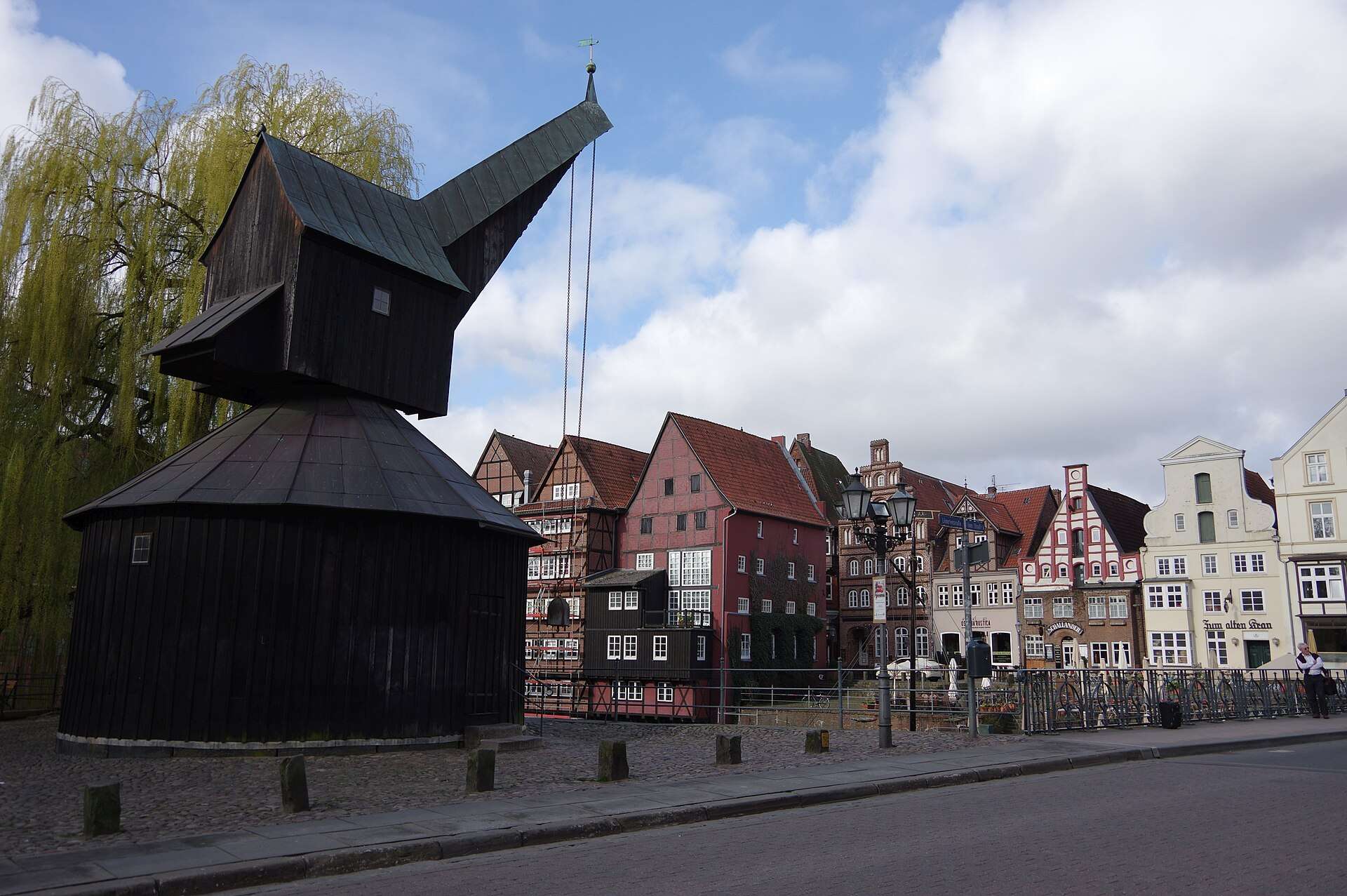
- The Stintmarkt harbor quarter carries the trade’s hardware: the old wooden crane on the Ilmenau — the port’s 18th-century workhorse — over a waterfront now running the town’s densest terraces, with the smelt (Stint) season as the late-winter eating tradition the name remembers.
- The German Salt Museum occupies the works themselves — the saline produced until 1980, a thousand-plus years after records begin — telling brine, boiling, and the wealth’s whole mechanics on the spot; the old water tower’s viewing deck adds the roofscape-from-above per the alarm’s optional climb.

Getting there
The half-hour frequency makes Lüneburg Hamburg’s easiest old-town escape — no bookings per the alarm, no timed anything, and a town compact enough that the station-to-crane walk tours half the highlights by accident. The route logic is a simple loop: Am Sande and the churches, the market square and town hall, the water quarter, and the salt works’ museum at the western edge where the sinking is strongest.
The day
Am Sande opens it: the gable parade walked slowly both directions, St. Johannis’ interior organ pedigree (a young Bach heard and studied here — the town wears the connection lightly) and its leaning tower checked against your own eye. The lanes toward the market pass the subsidence exhibit-in-place per the alarm — door frames off square, sills dipping, the sunken street corners the town labels rather than hides. The town hall’s facade and the market square handle midday; lunch runs the Stintmarkt terraces over the Ilmenau with the old crane as the view. The Salt Museum takes the afternoon hour: brine pans, the boiling house’s economics, and the 1980 closing told as the end of a thousand-year shift. The water tower’s deck closes the loop with the roofscape annotated from above — red tile, black brick, and the tilt visible once you know. The train home barely counts as a journey.
When to go
Year-round, plainly — the brick gothic and museums are all-weather, and the alarm’s book-nothing clause holds in every month. April through October opens the Ilmenau terraces and the town’s best strolling light; December mounts one of the north’s more atmospheric Christmas markets under the gables. Late winter brings Stint season — the little smelt fried in every water-quarter kitchen, the harbor’s old trade eaten in its own name. Summer Saturdays bring wedding parties to the town hall in charming density.
Frequently Asked Questions
Is the town really sinking?
It did — over the salt dome’s hollowed layers, with the worst movement through the 20th century as extraction peaked and stopped; whole facades tilted, some structures were lost, and the ground has largely settled since the saline closed in 1980. The surviving leans are stabilized and monitored. The alarm’s kept-and-loved framing is the town’s own attitude: the tilt is the biography made visible.
What’s the Bach connection?
Johann Sebastian Bach spent school years in Lüneburg around 1700 as a choir scholar at St. Michael’s, absorbing the town’s organ culture — the formative stop before the famous career. The churches note it without theming the town around it, which fits both the town and the composer’s teenage anonymity at the time.
Why did the saline matter so much?
Salt was the preservation economy: Lüneburg’s brine fed the Baltic herring trade through Lübeck, and the monopoly-era profits built everything the eye admires — the churches, the gables, the town hall’s splendor. The museum’s core exhibit is exactly that chain: brine pan to Hanseatic power, told on the site that boiled it.
Is the water tower climb worth it?
For orientation and the roofscape, yes — the 1907 tower’s deck (lift-assisted most of the way) reads the whole brick-gothic plan at once, tilt included per the alarm. It’s a modest fee and twenty minutes. Photographers take it late afternoon when the black brick warms.
Lüneburg or Lübeck from Hamburg?
Lübeck (documented on this network) for the Hanseatic capital itself — Holstentor, marzipan, the bigger ensemble at a slightly longer ride; Lüneburg for the salt that paid Lübeck’s bills, at half the crowds and thirty minutes. The two towns are one economy split by geography; the honest Hamburg base visits the money and the port both.