Bremen from Hamburg: The Hour’s Train, the Donkey’s Legs, and the Strangest Street in Germany
An hour southwest, the Hanseatic sister city keeps a UNESCO market square, a fairy-tale statue with a grabbing ritual, and one street of brick expressionism unlike anywhere else in Germany.
The short version
- IC and regional trains run Hamburg to Bremen in 55–75 minutes at high frequency on ordinary fares — times at bahn.de; the Marktplatz sits ten minutes’ walk from the station.
- The Town Musicians of Bremen — donkey, dog, cat, rooster stacked in bronze beside the Rathaus — anchor the Grimm tale the city adopted as identity; the both-hands-both-front-legs wish ritual is local law, polished into the metal.
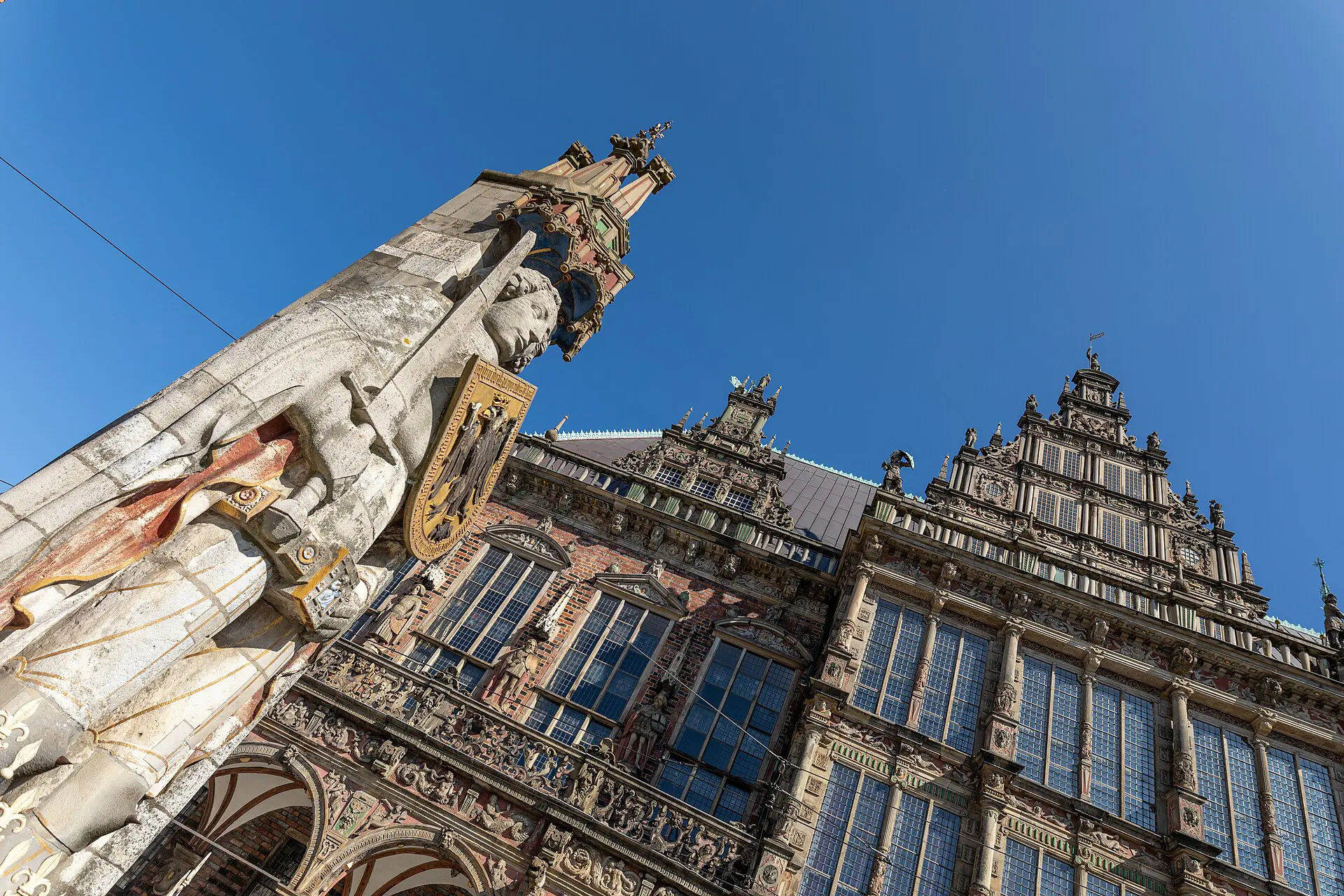
- The Rathaus and the Roland statue before it hold joint UNESCO status — Weser Renaissance civic swagger and the 1404 stone knight whose standing guarantees the city’s freedom by legend and, the city notes, by unbroken fact.
- Böttcherstrasse runs 100 meters of 1920s brick expressionism — a coffee magnate’s commissioned fever dream of arches, gold reliefs, and the Glockenspiel’s Meissen bells — the alarm’s look-up rule exists because the street works in the vertical.
- The Schnoor quarter’s 15th–16th-century lanes — the fishermen’s district shrunk to dollhouse scale — carry the browsing hour: sugar-beat bakeries, craft rooms, and corners a single umbrella can block.
- The Ratskeller pours from Germany’s oldest working wine cellar beneath the Rathaus, Beck’s runs brewery tours across the river for the industrial counterpoint, and October’s Freimarkt — 985 years running — is northern Germany’s biggest fair.

Getting there
The Hamburg–Bremen shuttle is Hanseatic Germany’s easiest inter-city hop: constant trains, ordinary fares, and a flat walk from the station past the windmill into the old town. Regional day tickets (Niedersachsen-Ticket) beat point-to-point for pairs and groups. No bookings anywhere in the day unless Beck’s tour or a Ratskeller table calls for one; Bremen runs on turn-up terms.
The day
Marktplatz first for the ensemble — Rathaus facade, Roland’s ten-foot certainty, the cathedral’s twin towers — then the Musicians ritual per the alarm’s exact choreography (both hands, both front legs, wish silently; the queue is short and international). Böttcherstrasse follows with neck craned: the Lichtbringer relief’s gold, the Paula Modersohn-Becker museum (the world’s first museum for a woman painter) for the art stop, the Glockenspiel’s scheduled chime if the hour cooperates. Lunch runs North Sea classics — Knipp for the brave, fish for the rest — before the Schnoor’s afternoon: lane-browsing, the Bremer Geschichtenhaus’s costumed corners, coffee in a room built when Columbus sailed. The Weser promenade’s Schlachte terraces or the Beck’s tour close the range, and the cathedral’s lead-cellar mummies wait for the morbidly curious. Trains home run past dinner without strain.
When to go
Bremen works year-round at even temper. Advent lights the Marktplatz and Schnoor into genuine postcard material; late October’s Freimarkt swallows the city in fairground for two weeks — join it or time around it. Summer adds the Schlachte’s riverside beer benches; grey Hanseatic winter suits the Ratskeller’s candlelit vaults. The Musicians accept wishes in all weathers.
Frequently Asked Questions
What’s the actual fairy tale?
Four aging animals flee their masters to become musicians in Bremen, scare off robbers with a stacked midnight chorus, and never actually reach the city — which Bremen finds funnier than anyone. The statue completes the journey the story didn’t.
Does the donkey ritual really require both legs?
By firm local convention: both hands on both front legs — one-handed grabs mark the uninstructed, and locals will correct you with pleasure. The wish is your own business. The shine on the fetlocks documents a century of compliance.
What is Böttcherstrasse exactly?
Coffee merchant Ludwig Roselius bought the lane in the 1920s and commissioned Bernhard Hoetger to rebuild it as expressionist Gesamtkunstwerk — brick fantasy, workshops, museums, bells. The Nazis hated it, which Roselius wore as endorsement. Nothing else in Germany looks like it.
Bremen or Lübeck from Hamburg?
Lübeck (documented on this network) for Gothic brick and marzipan gravity; Bremen for the market-square ensemble and the strangeness quotient. Both run about an hour; the Grimm statue and Böttcherstrasse give Bremen the family-and-photographer edge.
Is the Beck’s tour worth crossing the river?
For beer-process enthusiasts and brand loyalists, cheerfully — samples included, English slots limited, booking ahead advised. Everyone else does better with the Ratskeller’s 600-year wine list under the town hall.